


Penta Security WAF Stops Security False Positives
The Operational Calculus of Web Application Defense: Evaluating Penta Security WAF for High-Availability Networks
This systemic operational friction explains why sophisticated technology leaders prioritizing digital resilience look past broad marketing claims and focus heavily on execution precision. Modern multi-market enterprises require a defensive posture that remains uncompromisingly strict against true malicious exploitation, yet completely transparent and silent during non-malicious consumer behaviors. Decision makers need an analytical security architecture that inherently understands complex web application logic, eliminating the archaic pattern of converting standard organic API requests into an ongoing stream of critical internal remediation tickets.
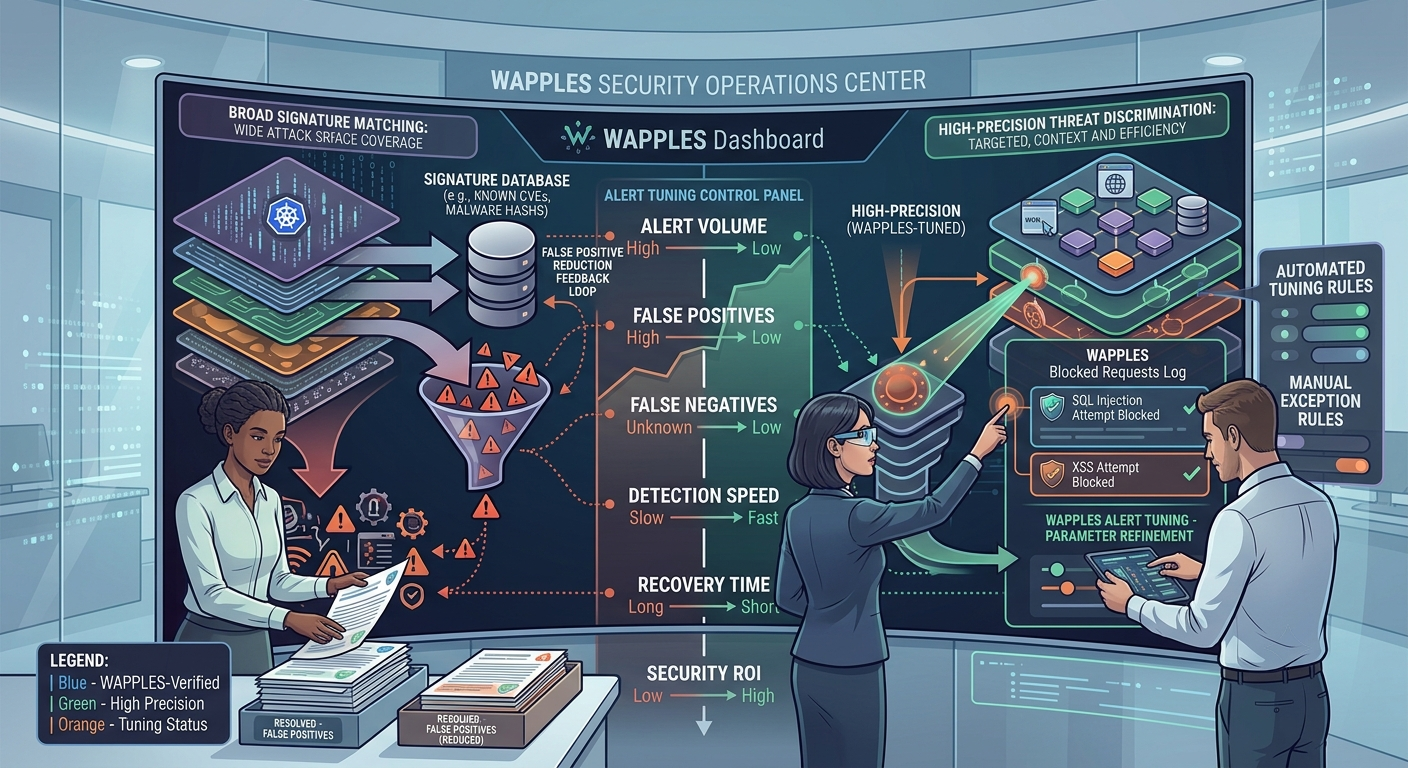
The Hidden Overhead of Legacy Signature Based Detection
On a standard procurement matrix, an overly aggressive web application firewall can initially appear effective due to the massive volume of blocked events reported on a static dashboard. In real world production environments, this continuous operational noise is typically an indicator of structural inefficiency. A noisy, uncalibrated security appliance generates significant hidden financial and operational costs across the modern enterprise, including persistent developer interruptions, delayed application deployment windows, convoluted application debugging cycles, and the long term technical depletion of an infrastructure group that no longer trusts its own alerting infrastructure.
Once internal engineering units lose operational trust in a security enforcement point, the platform transforms into a liability. To sustain business continuity and meet launch deadlines, infrastructure teams eventually begin to implement sweeping global bypass rules, delay critical threat signature updates, or construct overly permissive exception matrices. At that exact inflection point, the perimeter security platform ceases to reduce corporate risk. It has successfully generated a secondary layer of operational architecture that the engineering team must permanently manage.
The Penta Security WAF Methodology: Analytical Precision Over Brute Force
This precise operational bottleneck is the architectural challenge that Penta Security WAF addresses. By moving away from legacy, syntax matching models and utilizing intelligent logical and semantic analysis, the platform is intentionally engineered to reduce false positive pressure. The underlying architectural value extends far beyond the capacity to intercept advanced application attacks, it centers on an inspection engine that remains contextually aware of the web application data state. Consequently, enterprise资安 engineers can transition away from the tedious weekly routine of manually reviewing and pruning harmless traffic data.
This logical framework becomes an indispensable asset for enterprise organizations running complex, client facing web interfaces, heavily interconnected microservice APIs, and dynamic cloud environments that undergo continuous code updates. The more dynamic the application traffic pattern, the more likely a simplistic, signature based application firewall will misinterpret normal application behavior. A enterprise solution like Penta Security WAF, which mitigates this systemic friction, is fundamentally easier to sustain within a live production cluster over a multi year corporate lifecycle.

Why Discrimination Accuracy Dictates Total Cost of Ownership
For many years, traditional security paradigms conditioned technical groups to believe that a robust defense mandate required a massive volume of security telemetry alerts and disruptive firewall blocks. Modern multi cloud operations prove that this correlation is false. True protection depth is measured by discrimination accuracy. When a web application firewall interprets enterprise data traffic with high semantic precision, it can decisively terminate malicious web exploits while maintaining an unhindered path for legitimate, revenue generating transactions.
Penta Security WAF fits this modern operational standard by systematically minimizing the ongoing administrative burden of constant policy correction. Lean enterprise technology teams do not have the organizational luxury to function as full time rule archaeologists, endlessly reviewing historical text logs to fix a broken shopping cart or login sequence. They require an intelligent network control that remains consistently effective while the broader corporate scaling strategy introduces rapid architectural change.
This operational reality takes on critical importance in companies maintaining compact security management structures. When a small group of infrastructure engineers carries full responsibility for regional visibility, every single false alert carries an immediate financial and time cost. Precision is no longer an optional feature on a marketing brief, it is the determining variable between an architecture that scales with corporate growth and an architecture that collapses under the weight of its own internal noise.
The Deployment Advantage: Optimizing Time to Protection Velocity
The friction of excessive false positives does not simply degrade daily operations after a solution is live, it actively delays the initial implementation pipeline itself. Software engineering groups naturally resist rapid security integration rollouts when they anticipate that an uncalibrated perimeter appliance will disrupt standard business features. This systemic hesitation creates massive project delays before the cloud implementation even enters its primary production phase.
Conversely, when an application firewall is recognized for maintaining low noise thresholds, the migration conversation changes entirely. The engineering team can initiate the rollout from a highly secure baseline and safely iterate the configuration over time, rather than spending the first critical days of deployment undoing overly broad rule sets. This precision transforms Penta Security WAF from an implementation risk into a core deployment advantage across diverse application types.
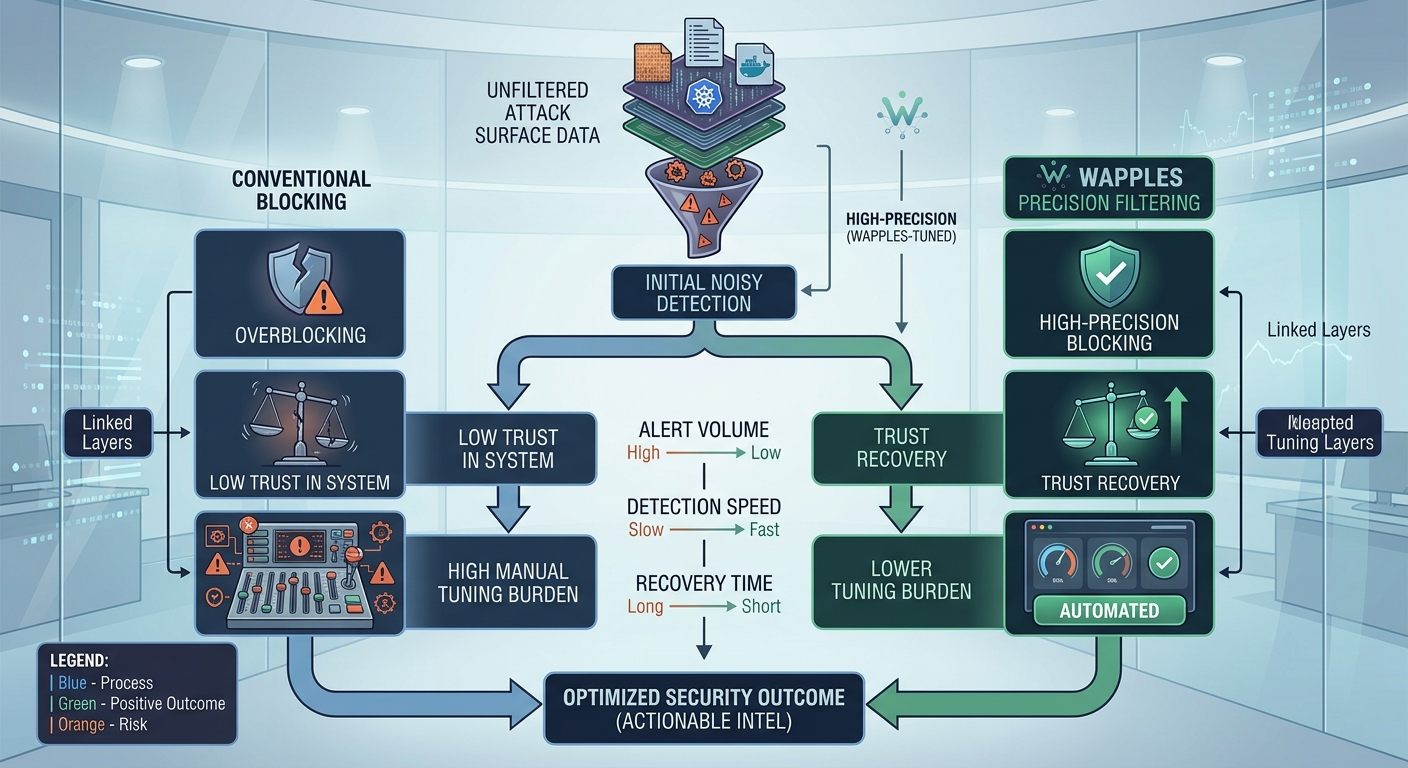
Ultimately, long term security platform survival depends on trust. Security technologies succeed when secondary engineering groups trust their behavior enough to keep them active in the production path. If the web application firewall induces random application outages through inaccurate blocking, business stakeholders will eventually view the tool as operational friction rather than a protective guardrail. A platform that systematically prevents avoidable firefighting is the one that permanently survives the corporate budget review cycle.
The Operational Precision Evaluation Framework
Enterprise procurement teams should utilize these four foundational operational metrics during the initial proof-of-concept phase to separate functional security from theater.
The Penta Security WAF engine stands out in high-availability markets because it is built for long-term operational viability. It replaces security theater with real world control, minimal noise, and a platform that stays active long after the initial deployment novelty wears off.
